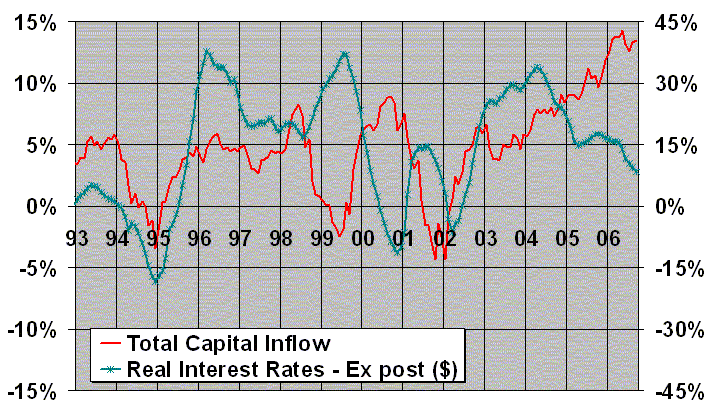
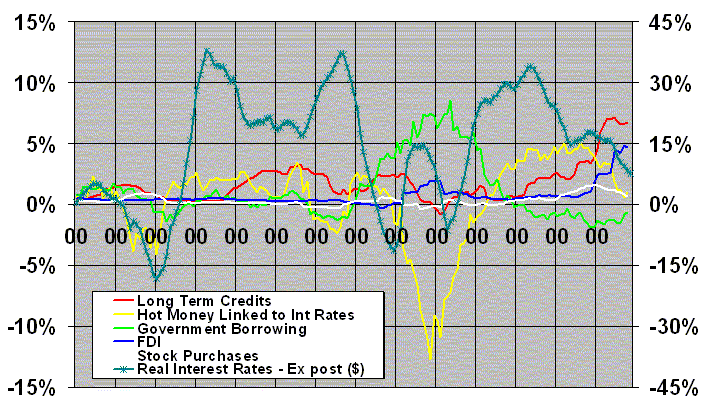
Raghuram Rajan, who is the head of research department at IMF caused quite a debate in Turkey with his recent speech at a conference in Wyoming (bad boy!). In sevral op-eds prominent Turkish economists cited that speech to prove the virtues of (semi) closed economy over an open one that allows free movement of capital.
What did Dr. Rajan said in Wyoming (home of the VP Cheney. Hmmm?)
Our conclusion is therefore that in the long run, capital account opening is unlikely to help poor countries grow by providing resources in excess of what is available in the domestic economy.
Countries that use less foreign finance, or export more savings, grow faster. Countries that invest more grow more than countries that invest less; but it is countries that invest more and save more (that is rely less on foreign capital) that do the best of all. In fact, within countries that invest more, those that save more (and thus run lower current account deficits) grow at a rate of about 1 percent a year more than countries that save less.
We find ... that controlling for domestic savings in our baseline regression eliminates the effect of the current account on growth but controlling for investment does not.
All this suggests that domestic savings rather than foreign savings are critical for growth.
In other words, it is good to save more and invest it. (You go Robinson Cruiso!). On the other hand, if for a variety of reasons you are not able to increase your savings (which is the case in Turkey), then what is your best course of action? I say let's borrow the savings of other countries and invest it to increase production capacity (but use that money wisely because you are going to pay it back with interest). This is the second-best option and in fact only option that we face in Turkey given that we are living in a democratic society and our elected leaders are likely to be reluctant to commit suicide by forcing their constituencies to adopt a China like savings rate.
Let me give a few numbers:
- Between 1960 and 2005, 1 percent increase in growth, on the average, has required an investment of 4.7 percent (of gdp) investment.
- That meansto achieve a 6 percent growth rate, we need 27 percent investment
- Average savings rate in Turkey in the same period was 20 percent.
- If we assume that the savings rate will be the same in the future, we need 7 percent foreign capital to make up the difference.
If you do not like this scenario, you only have two alternatives:
- Increase savings rate through high tax rates, low government spendings, or both (and commit political suicide)
- Increase the productivity of the economy.
How can we raise productivity? With more competition, new technologies, new business practices. In other words establish the rule of law in the country, cut the red tape, reduce corruption, invest on the infrastructure of the country, prevent oligopolistic business practices, create a competitive business environment, and of course attract more foreign direct investment.
Until then, the country needs foreign capital to grow.