
Showing posts with label Energy. Show all posts
Showing posts with label Energy. Show all posts
Thursday, June 07, 2007
What Lies Beneath?
If you are looking for the culprit of Turkey's trade deficit, the figure below may give you a clue... Keep in mind that the economy contracted significantly in 1994, 1999, and 2001.


Tuesday, March 06, 2007
It's the oil, stupid!
Turkey has been experiencing a significant trade deficit since 2003. Is it because the country imports too much and/or exports too little due to appreciation of the local currency?
Two tables below explain the problem. The main culpit is the high energy prices. The ratio of manufacturing exports to intermediate goods has never been higher. Ditto for the export/import ratio -- IF ONE EXCLUDES ENERGY BILL.


If there we no change in the energy prices, the ratio of exports to imports would be much better:
Figure: The ratio of exports to imports under 2000 prices

Two tables below explain the problem. The main culpit is the high energy prices. The ratio of manufacturing exports to intermediate goods has never been higher. Ditto for the export/import ratio -- IF ONE EXCLUDES ENERGY BILL.


If there we no change in the energy prices, the ratio of exports to imports would be much better:
Figure: The ratio of exports to imports under 2000 prices

Sunday, September 24, 2006
Current Account Deficit in Turkey
In his weekly briefing at Global Economic Forum, Serhan Cevik of Morgan Stanley wrote that:
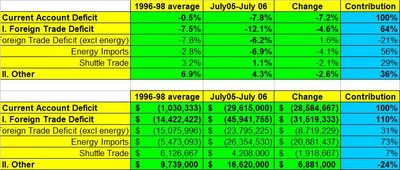
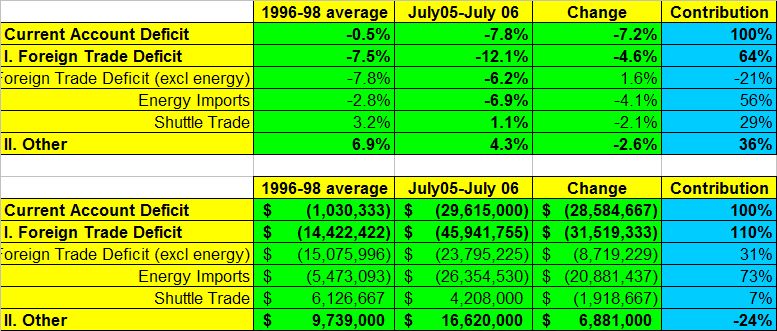
It is good to see that somebody is paying attention to the reasons behind Turkey's high CAD in recent years. To clarify the point further I put a small table below that gives you the breakdown of the CAD. If the energy prices were at their 1996-98 rate, the CAD would be 2.6%. The net contribution of trade deficit to the CAD is in fact negative , once energy imports are excluded. In the second table, we can see that although the CAD has increased by 29 billion dollars, rise in energy imports explains 21 billion dollars of that.If the decline in commodity prices is a trend shift, Turkey stands to benefit a lot. The shock of soaring commodity prices has been a major contributor to Turkey’s inflation and current account troubles. This is of course not surprising, given its growing dependence on imported sources of energy.... [N]et energy imports surged from 4.4% of GDP in 2003 to 5.2% in 2005 and 6.5% this year, accounting for more than 70% of the worsening in the current account deficit from 4.4% of GDP in 2003 to 7.4% this year. This is why we have always been careful about passing judgment on external imbalances of the Turkish economy.
Subscribe to:
Posts (Atom)

